Your Chevy Bolt is plugged into an Orange County stall. The session never starts. The dash stays quiet, or it says unable to charge. That failure is common on this county’s public banks. It is not always a dead pack. Check the stall, the port, and the 12-volt first. If the pack will still take power, a mobile Level 2 can still help. That charge at the curb can add range without a tow.
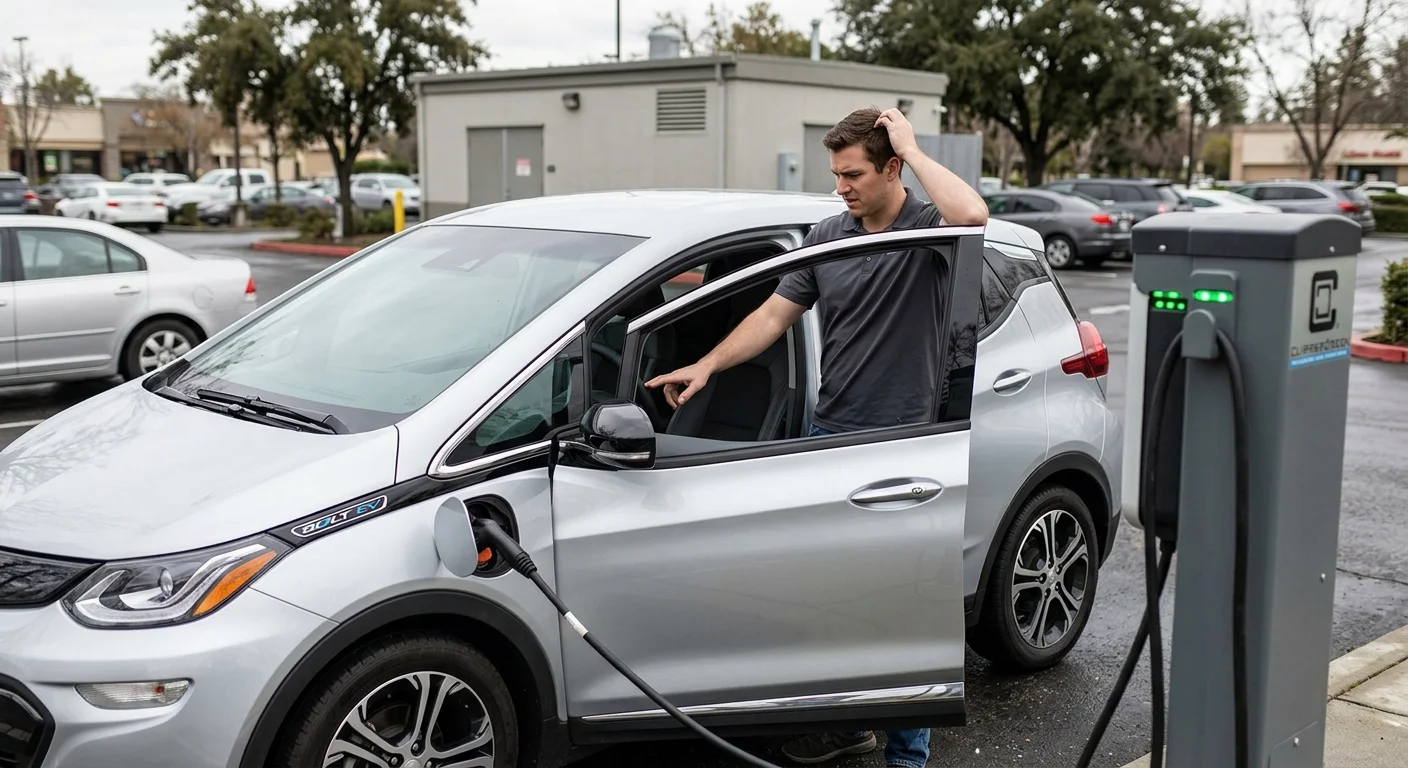
A Bolt uses a different slice of Orange County’s plugs
The California Energy Commission publishes the county’s battery-electric count. As of December 31, 2025, Orange County had 210,842 of them. Tesla accounted for 138,121, or 65.51 percent of that BEV fleet. Your Bolt sits in the remaining share with every other non-Tesla. The fast-charge map follows that split more than most drivers notice.
AFDC records 1,452 public DC fast ports in the county. Tesla holds 861 of those ports, about 59 percent. Those Superchargers serve a Model Y. They do not serve a Bolt by default. A CCS Magic Dock stall is the exception. Most Supercharger sites here are NACS only. A CCS Bolt can use the other 591 DC fast ports. Electrify America, EVgo, EVCS, and scattered ChargePoint plugs make up that group.
Public Level 2 is a bigger pool. The CEC file listed 5,600 public Level 2 ports at year-end 2025. Public ports in total were 7,095. Orange County had 36.8 ZEVs per public port. California’s ratio was 24.4. More cars per stall means more failed sessions on a busy night. Treat a dead session as a stall problem first. Then test the car.
Orange County holds 12.02 percent of California’s battery-electric cars. It is only 8.33 percent of the state’s light-duty fleet. That extra EV density shows up at the plug. A public stall here is a tighter share than the statewide average.
Start outside the car
Charging needs the station, the handle, and the Bolt to agree. Any one of them can stop current. Read the stall screen before you open the driver’s door. A dark screen is your cue to move. So is a stuck starting state or a station fault. Try the next plug on the same island. Then try a different island in that lot.
A Bolt takes J1772 for Level 2. It takes CCS for DC fast. Match the handle to the port. A Tesla NACS handle will not latch in a Bolt. Do not force it. A Tesla-only Supercharger row is the wrong line. Walk the lot for CCS or J1772 labels first.
Push the handle in until the port latch grabs. If it never catches, unplug, wait a few seconds, and try again. Check the pins for grit, film, or moisture. Coastal lots pick up salt. Inland lots pick up dust. Either coating can break the handshake. Two dead stalls in one lot usually means the station. One dead stall and a live neighbor usually means that unit.
When the bank is clearly down, leave it. Look up a second site instead of waiting it out. The stall-side order is also in our public charger dead checklist.
A home plug fails for different reasons
A garage session that never starts is often the circuit, not the Bolt. Seat the cable at the wall and at the port. Find the breaker that feeds that charger. Reset it once if it has tripped. If it trips again, stop using that circuit. That is a house-power problem. It is not a job for a roadside charge.
Swap cables if you have a spare. Damage hides under the jacket. Level 1, Level 2, and DC fast are separate systems. A failed mall DC stall does not prove your home J1772 is toast. Test one source at a time so you know which path broke.
Unable to charge is a handshake alert, not a parts list
Unable to charge means the session never negotiated. It does not name the failed piece. The Bolt and the station talk before any current flows. They agree on limits and safety. If that talk fails, the car refuses on purpose. That protects the pack.
A flaky stall can trip the same alert. So can a half-seated handle. So can a 12-volt system that never wakes the charge module. One failed stall is weak evidence. The same alert on a second stall starts to look like the car. Still check the 12-volt before you book a dealer.
Other Chevys throw a similar wall. If you also drive an Equinox EV, use the Equinox EV won’t-charge checks. The outside-in order is the same idea.
A weak 12-volt can block a pack that still has miles
The high-voltage pack moves the car. The small 12-volt battery runs the computers that allow charging to start. When that 12-volt sags, the Bolt may not wake. Screens stay dark. Locks act odd. The charge port ignores a good handle. The dash can still show range. The car still will not take a plug.
On a Bolt, that 12-volt sits under the hood. It is usually on the driver’s side. Look for white or green crust on the terminals. Do not touch orange high-voltage cables. A look is enough in a lot. Jumping or replacing that battery is easy to get wrong on an EV. The operators we connect you with jump a dead 12-volt on site. They can replace it when that is the fault.
Flickering accessories are a clue. A port that will not acknowledge the handle is a clue. A car that will not power up is a clue. Lead with the 12-volt in those cases. A dealer tow for a sleepy 12-volt is a long wait. A jump at the curb is often the whole fix. Then you can try the stall again.
Power-cycle once, then stop looping
If the stall looks live, cycle the charge system once. Unplug the handle. Shut the Bolt fully down. Open and close the driver’s door. Wait a few minutes so modules sleep. Power the car back on. Plug in again.
That sequence clears a stuck charge-control state more often than it should. It is not a repair. If the session still refuses after one cycle and a second stall, stop. Repeating the same reset does not add information. You already know you need a person at the car.
When a public stall refuses, mobile Level 2 can still help
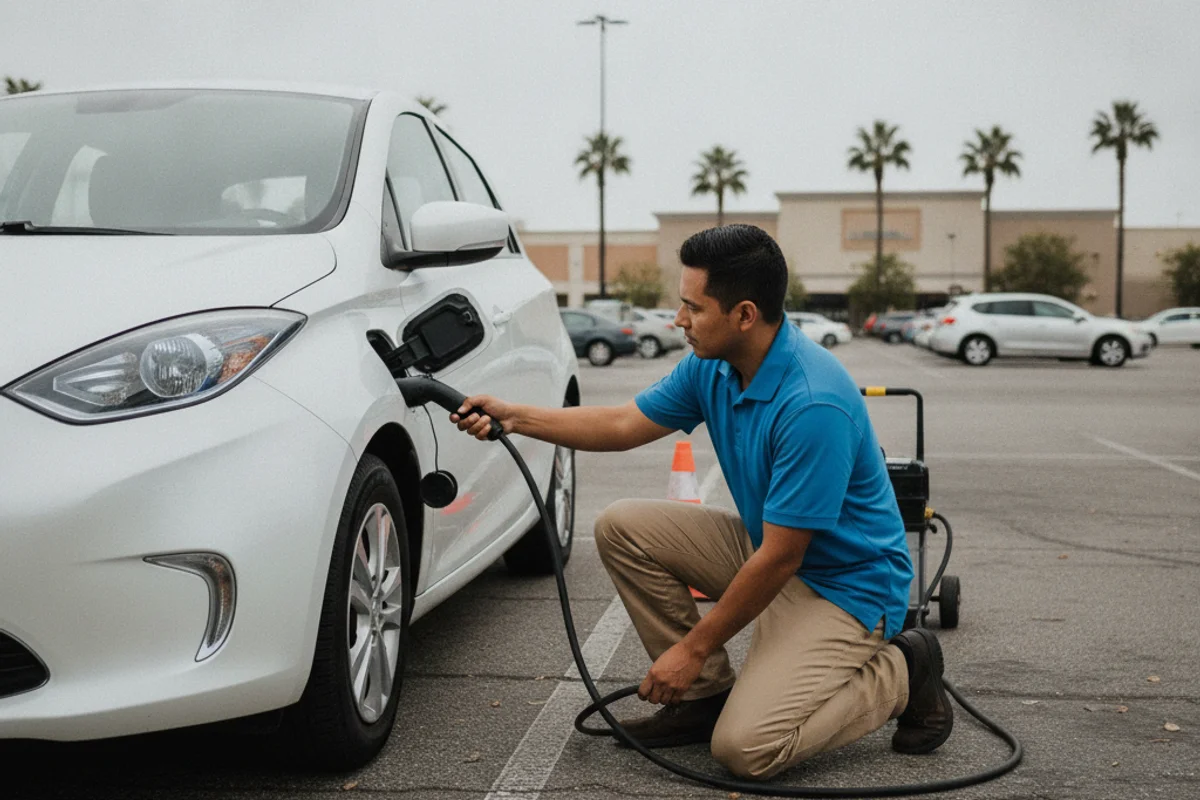
A Bolt that refuses a public DC stall can still take 240-volt AC. The onboard charger is a different path from the CCS fast pins. That is why a mobile Level 2 visit still has a job. The operator brings a 240-volt source to the car. For a Bolt, that means a J1772 handle. CCS adapters cover other non-Tesla EVs on the same truck. Typical charging time is 15 to 30 minutes. That is time on the plug, never a promise of when someone arrives. It usually adds about 10 to 20 miles of range. That is enough to reach a working stall. It is not a full pack.
Charge Pro OC is a referral line. We match stranded drivers with independent local operators. We own no trucks and we send no in-house techs. The operator quotes you before starting. The operator bills you directly.
This is the useful call when you are already parked and the bank is dead. It is also the call when rolling off a shoulder is not safe. Read how mobile EV charging works here. For a Bolt, start with non-Tesla EV rescue.
North county lots in Anaheim and Fullerton sit beside large Tesla banks. A Bolt cannot use those stalls. Buena Park auto row has the same mix. Central lots in Santa Ana, Garden Grove, and Orange mix Level 2 and Tesla DC. Coastal lots in Newport Beach and Seal Beach add heat after a beach day. South county sites along I-5 have bigger CCS banks. Same county. Different handle in front of you. The check order stays the same. The next plug that actually fits changes.
Named DC fast sites a CCS Bolt can use
You do not need a guessed distance. These sites are in the federal AFDC station file, accessed September 5, 2026.
Electrify America at 440 N Euclid Street in Anaheim lists 10 DC fast ports. That Walmart bank is a CCS option in north county. A Tesla Supercharger also sits at 680 N Euclid Street. Sixteen NACS stalls, and they will not fit your Bolt. Both sit on Euclid. Confirm which handle you are holding.
Theme-park and stadium lots along Lincoln and Katella are Tesla-heavy. 1128 W Lincoln Avenue has 16 Supercharger stalls. 1734 W Lincoln Avenue has 20. 2270 E Lincoln Avenue has 20. 2404 E Katella Avenue has 16. None of those help a CCS Bolt. Use the Euclid Electrify America bank instead if you can still roll.
Electrify America at Fashion Island lists 8 DC fast ports. The address is 401 Newport Center Drive in Newport Beach. If you stalled in that structure, use the Fashion Island charging walk-through. Electrify America’s Dana Point Station lists 12 DC fast ports. The address is 25825 Las Vegas in Capistrano Beach. In that file, it is the largest non-Tesla DC site in south Orange County.
EVgo at Plaza Antonio in Rancho Santa Margarita lists 14 DC fast ports. The address is 22351 Antonio Parkway. EVgo at Ocean View Plaza in San Clemente lists 10 DC fast ports. That address is 638 Camino de los Mares. EVgo at 801 Pacific Coast Highway in Seal Beach lists 4 stalls. EVgo at 27542 Antonio Parkway in Ladera Ranch lists 8.
Tesla’s Lake Forest site at 24372 Rockfield Boulevard is listed with Magic Dock. That listing is CCS1 plus NACS, at up to 325 kW. A CCS Bolt can use that site when the dock is in CCS mode. Confirm the stall mode before you count on it. The 40-stall Tesla site at 1920 Main Street in Irvine is NACS. It is not a Bolt backup. The San Clemente Supercharger at 101 W Avenida Vista Hermosa has 49 stalls. Those are Tesla stalls. Plan on the EVgo bank on Camino de los Mares instead.
ChargePoint pins are easy to over-read. AFDC counted 71 ChargePoint DC fast stations in Orange County and only 76 ports. Most are single-plug dealership or office units. An icon on your phone can be one stall in a service drive. That is not the same as a 10-stall Electrify America island. If the pack is too low to reach a live CCS bank, call. Get a charge at the car.
Bring a charge to the Bolt before you call a tow
A tow only moves the car. It does not explain a refused session. Many won’t-charge calls are a dead 12-volt or a bad stall. Some are a port that needed a reseat. Those get solved where you sit. A dealer trip for that is a long day for a short fix.
Tow when the car is damaged. Tow when the pack will not accept any power after a 12-volt jump. Tow when you cannot stay put. For an empty pack or a refused stall, on-site charging is the cleaner first call. The choice is laid out in mobile charging or a tow.
If you are on a freeway shoulder, stay out of live lanes. Hazards on. Sit behind a barrier if there is one. Do not test a second stall on I-5, I-405, SR-22, or the 91. Stabilize the car. Then get a 240-volt source brought to it.
If the checks still leave you stuck
You tried a second stall. You reseated the handle. You cycled the car once. The 12-volt still looks weak, or J1772 still will not start. That is the call. Charge Pro OC will connect you with a local operator. That operator can jump the 12-volt at the car. They can add a Level 2 charge if the pack will take it. Call (949) 444-0151. The operator quotes you before starting.