A Chevy Blazer EV that won’t start after sitting in an Orange County lot is usually the 12-volt battery. The Ultium pack can still show charge in the app. The car can still refuse to wake. Door locks and the center screen run on that small 12V. So do the modules that authorize high voltage. After a long park in Anaheim, Irvine, or Huntington Beach, that’s the failure you get.
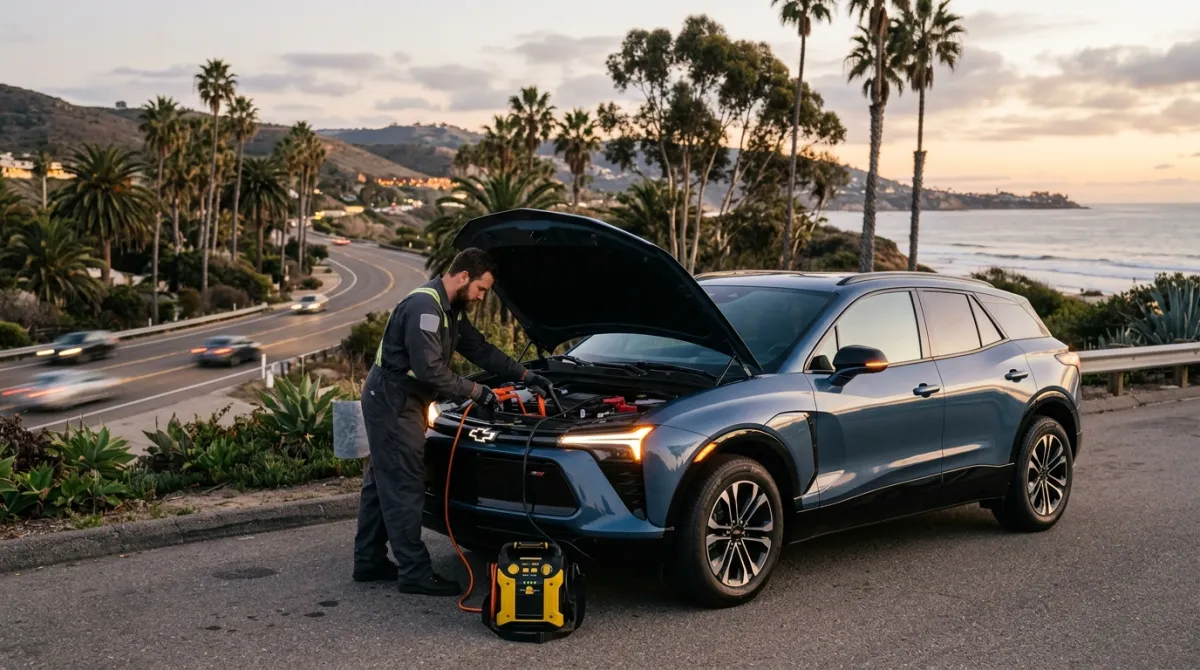
Why a Blazer EV dies in an Orange County lot
You left it sitting. You came back. The fob does nothing.
That’s the local pattern, not an empty pack on the freeway. Theme-park days in Anaheim run long. Office parks in Irvine and Tustin do too. Beach parking in Huntington Beach keeps a car still through a hot afternoon. Quiet garages in Mission Viejo and Lake Forest can leave a Blazer EV parked for hours. Costa Mesa airport structures add the same sit. None of that has to empty the traction pack. It can still flatten the 12V.
The California Energy Commission counted 210,842 battery-electric vehicles in Orange County. That figure is as of December 31, 2025. ZEVs are 10.56% of the county’s light-duty fleet. Orange County holds 12.02% of California’s battery-electric cars. It’s only 8.33% of the state’s light-duty fleet. Tesla makes up 65.51% of those BEVs. GM Ultium crossovers share the rest of that row. The Blazer EV, Equinox EV, and Lyriq share the same 12V-first no-start.
Public ports here are busy. The CEC counted 7,095 public ports in the county on that same date. That’s 36.8 ZEVs per public port. The statewide ratio is 24.4 ZEVs per port. A nearby stall still doesn’t wake a car that won’t boot. If the screen is dark, skip the charger hunt. Treat the 12V first.
Two batteries, and only one wakes the car
Every production EV has two electrical systems. The Ultium pack turns the motors. A conventional 12V battery runs everything else. If that 12V is down, the car won’t enter Ready. A healthy percent in the myChevrolet app doesn’t change that.
On the Blazer EV, the 12V lives in the front trunk. It’s under a plastic cover. There’s no engine bay to search. If the 12V still has some charge, the frunk should open. Use the interior switch or the key fob. If it’s fully dead, the latch is electric. Use the manual release in the owner’s manual. Don’t force the lid.
Jump posts aren’t the battery terminals. They sit on a dedicated bar in the front compartment. The positive post has a red cap. The negative is a chassis bolt nearby. Clip a jump pack to those points. Wait about a minute, then press start. Clamping the battery posts themselves is the wrong move.
The Cadillac Lyriq uses the same Ultium layout. Our Lyriq no-start checks show the same front-compartment idea. The Equinox EV lot checks follow the same 12V logic.
What the screen is telling you
The Blazer EV’s center display is a useful tell. Read it before you call a tow.
| What you see | Likely cause | First move |
|---|---|---|
| Dark screen, no dome light, fob dead | 12V is fully down | Jump the front posts |
| Dark screen, doors still unlock | 12V is low, not empty | Jump pack, then start |
| Screen flashes on and off | Control modules stuck in a boot loop | 12V power cycle |
| Screen loads, Service warning, no Ready | Ultium fault | Power cycle, then a dealer |
| Charge-port locked icon | Latch error | Free the port before you force Ready |
Total darkness with no fob response is the lot-sit case. A jump pack on the front bar usually brings the modules back. Give them a short wait. Then try a normal start.
If the app still shows a healthy pack, you don’t need a DC stall yet. Anaheim has Superchargers on Lincoln and Katella, including 16 stalls at 2404 E Katella Ave. Irvine has 40 stalls at 1920 Main St. Newport Beach has Electrify America at 401 Newport Center Dr, by Fashion Island. Those sites matter when the pack is empty and the car will drive. They do nothing for a dark 12V.
A software hang can mimic a dead battery
Early Blazer EV builds had a rough software period. In late 2023 and into 2024, GM paused new deliveries. The pause covered no-start and charge-session software faults. Over-the-air updates followed. Some VINs later needed a dealer flash. Ask a Chevrolet dealer whether your car has the update. Don’t guess from a forum thread.
A software no-start doesn’t look like a fully dead 12V.
- The screen wakes, then dies, or the boot animation never finishes.
- Ready appears for a moment, then drops.
- You see “Service EV System” or “Service High Voltage Charging System.”
- The app still shows a normal charge. The car still won’t drive.
The field reset is a 12V power cycle. Open the frunk. Disconnect the negative 12V terminal. Leave it off for two full minutes. Reconnect it, then wait for relays to click as modules come back. Then try a normal start. That clears volatile memory in the body controllers. It lets the battery management system boot clean.
If high-voltage warnings stay after that reset, stop. That’s a dealer scan, not a curb experiment. Don’t force a charge session on an active Ultium fault.
Empty pack versus a silent 12V
These two failures get mixed up on the street. They’re not the same job.
A dead 12V means a dark cabin and no Ready. The pack may still show miles in the app. Jump or replace the 12V. Then the car should boot.
An empty Ultium pack is different. The cabin may still have some 12V life. You still aren’t going far. Tesla’s Model Y owner’s manual says the low-voltage battery can lose support once range is gone. It then needs external power before the high-voltage pack can charge. GM doesn’t publish that same sentence for the Blazer EV. The practical read is similar. If both systems are down, the 12V has to come up first.
Orange County’s public DC map is Tesla-heavy. AFDC data shows 223 DC fast stations in the county. That’s 1,452 DC fast ports. Tesla holds 861 of those ports, about 59%. A Blazer EV that can drive can use CCS sites. Electrify America at 440 N Euclid St in Anaheim is one. EVgo at 22351 Antonio Pkwy in Rancho Santa Margarita is another. None of that helps until the 12V is alive.
If the pack is truly empty after the car wakes, stay with the vehicle. A tow to a stall is the last move, not the first. Charge Pro OC is a referral line. It matches stranded drivers with independent local operators. Those operators bring a 240V Level 2 source to the car. They use a native NACS plug. Non-Tesla EVs get a CCS or J1772 adapter. Charging time is typically 15 to 30 minutes. That usually adds about 10 to 20 miles of range. That’s charging time, not an arrival window. See non-Tesla EV rescue and how to jump an EV on site.
What to do in the lot, in order
Stay with the car if you’re in a structure or a private lot. Don’t wander looking for a plug while the fob is dead.
- Try the fob and the door handle. Note whether anything lights.
- Check the myChevrolet app for pack percent and alerts.
- If you can open the frunk, find the jump bar, not the battery posts.
- Connect a jump pack. Wait. Then press start.
- If it boots and a 12V warning remains, plan a replacement. Drive to a Chevrolet dealer when it’s safe. Our 12V replacement signs guide covers that next step.
- If you can’t open the frunk, use the manual release in the owner’s manual.
- If the car wakes but has no range, you need a charge, not another jump.
Coastal heat in Huntington Beach and Newport Beach is hard on a weak 12V. Inland lots in Anaheim, Fullerton, and Santa Ana bake a parked crossover the same way. Buena Park auto-row parking adds long sits on Beach Blvd and Knott Ave. South County office parks in Irvine and Lake Forest add hours of quiet. Tell the operator if you’re behind a gate. Charge Pro OC doesn’t own trucks. It doesn’t employ technicians. It doesn’t set a price. The operator quotes you before work starts and bills you directly.
When a tow is the wrong first call
A dark Blazer EV on a flat lot doesn’t need a rollback yet. Moving an Ultium vehicle with no 12V is a shop problem if the systems aren’t awake. Get the low-voltage system up first. If a dealer scan is required, then you can plan transport.
Freeway shoulders are a different scene. If you’re on the 91, I-5, I-405, or SR-22, stay with the car when that’s the safe choice. Stay put and use hazards. Don’t cross lanes for a plug. The same 12V checks still apply once you’re out of traffic. For why the whole car looks dead, read when the 12-volt dies.
We serve every city in Orange County. That includes coastal towns, inland north county, central Santa Ana and Orange, East County hills, and South County.
Frequently asked questions
How do you jump a Chevy Blazer EV?
Open the front trunk with the interior release or the fob. If the 12V is fully dead, use the manual release in the owner’s manual. Under the plastic cover, find the jump bar. Clip the jump pack’s positive lead to the red-capped post. Clip the negative to the chassis ground bolt, not the battery post. Wait about a minute, then press start. If you don’t have a pack, ask for a local operator. The operator can jump or replace the 12V on site.
What does a dark Blazer EV screen mean?
A fully dark screen with no dome light and no fob response means the 12V is dead. The center display doesn’t run on the Ultium pack. No 12V means no screen, no locks, and no high-voltage handshake. A jump on the front bar is the usual lot fix. If the screen flashes or shows a Service warning, treat it as a module hang. Do the two-minute negative disconnect before you assume you need a tow.
Can a Blazer EV refuse to start with a full pack?
Yes. A battery-management or body-module fault can block Ready even when the app shows a full Ultium pack. That showed up on early builds. A 12V power cycle is the first reset to try. If the warning returns, a Chevrolet dealer needs to scan the car. Ask whether your VIN has the software update from that 2023 to 2024 period. Don’t keep jumping a battery that dies again the next morning. Replace it.
If your Chevy Blazer EV won’t start anywhere in Orange County, call Charge Pro OC at (949) 444-0151. We’ll connect you with a local operator who can jump the 12V or put 240V on a CCS port at the car.